|


| |
My Woodwork Bench
The
"great" folks at The Taunton Press (publishers of Fine WoodWorking
magazine) have given me permission to build and sell this workbench based on their
original design.
Note - the tool chest is a Swiger WoodWorks design.
See "What Inspired Me" to
build this bench at the
bottom of this page.

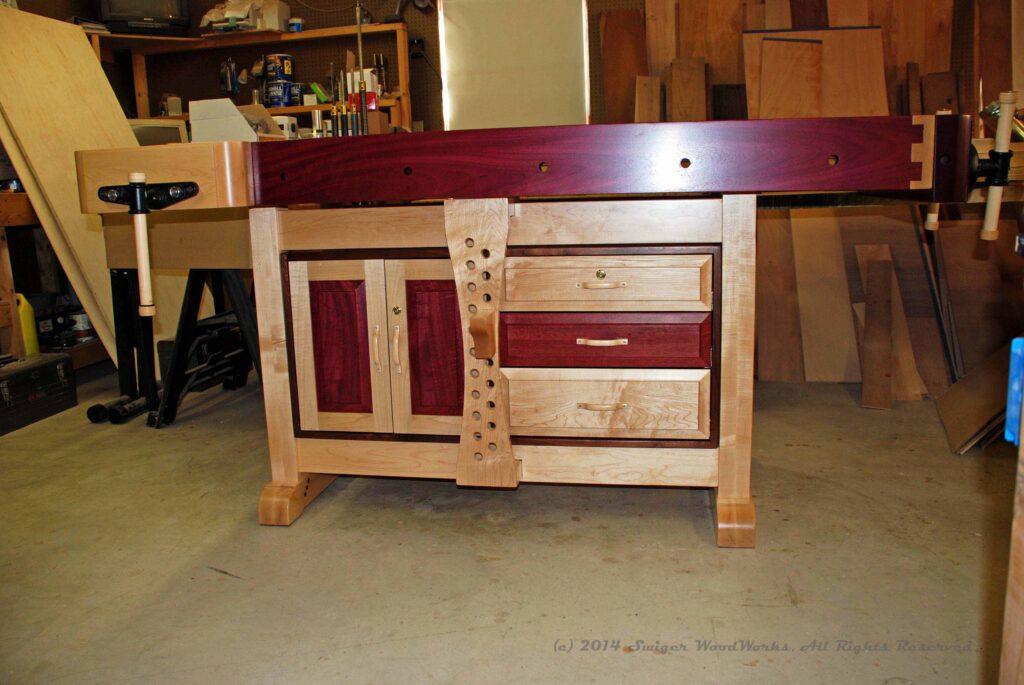
This bench, as shown, is made of hard maple
with purpleheart used for the front apron, end vise jaw, and other cabinet and
drawer pieces.
This is an extremely well crafted, serious woodworking/cabinetmakers bench that any
woodworker or woodturner would be proud to own and have in his/her shop.
It is intended for those that demand an upper end product. I take orders
to build benches on a commission bases, $500 down at time of
contracting to show good faith and to reserve a slot in my build schedule, the remainder of half down
due approximately two weeks prior to start of work (I'll contact you for payment), the
remaining balance due at time of
delivery or prior to shipping. I will provide free personal delivery
within 250 miles of my shop. Mapquest at
http://www.mapquest.com/directions/main.adp?
used for mileage determination. This bench can also be shipped,
and shipping and handling charges will apply.
I limit myself to building only two or three benches a year based on a first come, first
served basis. Manufacturing time is approximately three months from start of
work, but at times I do build a bench for sale so I may have one under
construction.
If you are interested in a couple of higher resolution photos of this bench,
send me an email requesting bench pictures: dave@swigerwoodworks.com.
In addition, I'll be glad to answer any questions you may have.
To obtain a cost quote, please review the features below and send me an
email identifying the key features you would prefer: dave@swigerwoodworks.com.
I'll get back to you promptly with your quote.
Bench Features
 | Woods - Hard Maple with Purpleheart front apron and end jaw vise. Optional
close-grained wood selections include oak and beech. Many European
benches are built with beech. I will also consider other wood choices. |
 | The Top - solid, 2½ in. thick with lots of workspace at 28¾ in.
wide by 77¼ in. long. Note - tops are built to within a tolerance of
+ ¼ inch. This is due to the natural bowing that occurs when
ripping slab strips from wider stock that must be corrected for when
flattening the bench. I rough cut the slab strips just shy of 3 in. and
maintain as much thickness as possible. Thicker bench slabs can be
built for an additional cost. |
 | Bench Height - The nominal height of the working surface is 35 in.,
but this varies depending on the resulting table top thickness after
flattening. If you have a requirement for something higher, I can
accommodate it. |
 | Heavy Duty Trestle Base - 3 x 3 in. leg members with 1¾ x 4 in.
stretchers that are joined with mortise and tenons providing for a solid
bench foundation that will not wrack or skid across the floor during heavy
work sessions. Most commercially available benches on the market have
spindly 2 x 4 in. legs and stretchers that don't provide the solid foundation
that is required of a good bench. |
 | Tool Tray - 6 in. wide tool tray. The tool tray is optional;
however, if you elect "not" to have one, the bench is
reduced to 28 inches wide. |
 | Front Apron and End Caps - at 1¾ x 6 in. they provide great strength and add
to the massive look to the bench. |
 | Front and End Jaw Vises - massive, 3½ in. thick providing for great
performance and secure clamping. Vises can be mounted at either end of
bench. |
 | Front Vise - Quick release, German made vise from Woodcraft. A half
turn counterclockwise releases the vise so that it can be slid out
easily. Other front vise selections possible if you prefer something
different. |
 | End Vise - Veritas Twin-Screw Vise from Lee Valley. Veritas claims
this is the only full-width "non-racking" end vise on the
market. You can clamp anything anywhere in the vise and the jaws stay
parallel. This vise also features controlled jaw skewing through the
use of a simply operated spring-loaded lock pin. It can be operated
using either handle and the speed knob can be set up for either right or
left hand operation. I will mount other end vises if you prefer
something different. This vise may also be mounted as a front vise. |
 | Square Dog Holes - 4 rows, 10 holes each, are aligned for use with the end
vise. Maximum clamping capacity is approximately 68 in. |
 | Round Dog Holes - 2 rows of ¾ in. holes, 7 holes each, are aligned with
the front vise. Maximum clamping capacity is approximately 34 in. The use of round dogs allows for clamping odd shaped pieces to
the table. ¾ inch holes also allow for the use of
hold-downs and holdfasts, as well as allowing for the securing of jigs that
are made with ¾ in. dowels. |
 | I deliver four Veritas square bench dogs with solid brass faces and four
Veritas solid brass round dogs with each bench. Brass is gentler to
your tool's edge, chisels, planes, etc. - if you happen to slip! |
Tool Chest
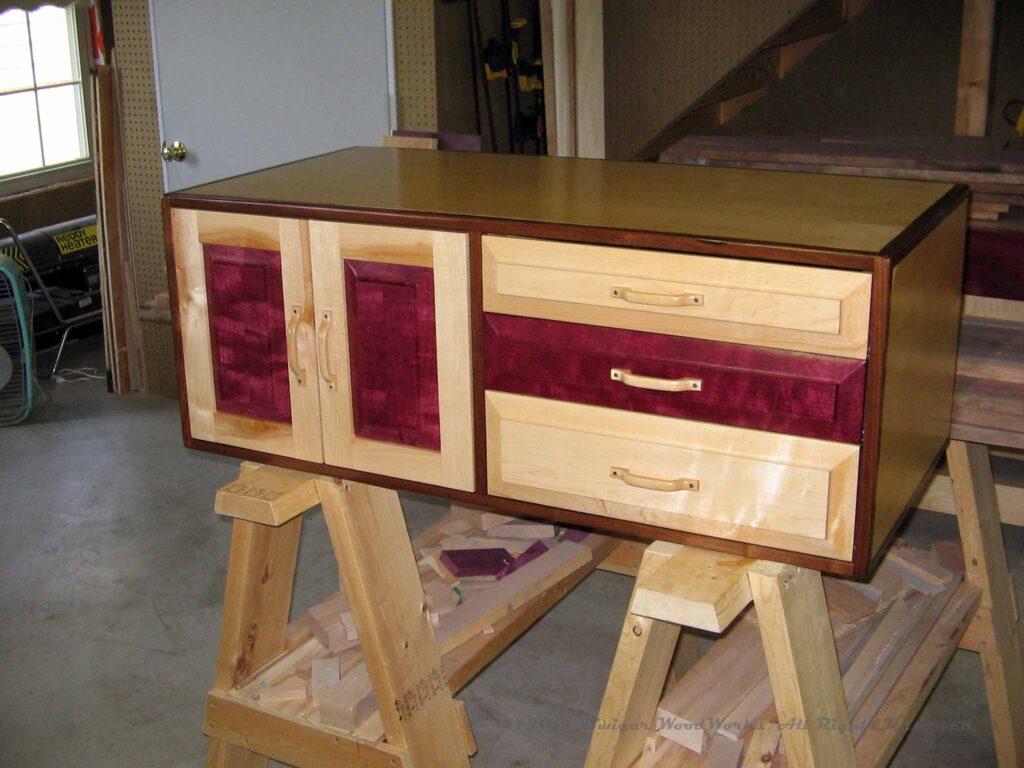
 | Woods - the cabinet is constructed of ¾ in. maple plywood that is edged
with walnut - walnut does a great job of defining and accenting the cabinet
area. Paying attention to such detail adds to the overall
integrated look of the bench which is artistically pleasing to the eye.
Other wood selections are available to match bench
construction selections. |
 | Drawers - the drawers are constructed with poplar and faced with matching
bench construction selections. In the photos shown, the top and bottom drawers are faced with maple and the middle
drawer is faced with purpleheart. The drawers are constructed using
box joints which provide for superior strength joints that will stand up to
years of abuse of banging tools as the drawers are opened and closed. |
 | Slides - the drawers are mounted on Blum Tandem, Full Extension, Fully
Concealed Slides. These slides have a smooth ball bearing movement,
are self-closing, and have a 100 pound weight capacity. |
 | Doors - the frame-and-raised-panels doors add yet another touch of
distinctiveness to the bench. As shown, the door rails and stiles are
maple, and the raised panels are purpleheart. Again, other wood
selections are available to match bench construction selections. If
you are not interested in the larger storage area these doors provide, you
may elect to have additional drawers installed. |
 | Wooden Pulls - wooden drawer and door pulls are available in maple
(shown), oak, or cherry. Metal pulls of your liking can also be used. |
Additionally, for those who want to build
their own bench, but don't have a heavy duty tablesaw (recommend at least a 3 HP
saw) to cut slab strips, I will custom build you a bench slab. Send me your dimension requirements and I'll send
you a price.
Some additional photos.
For some manufacturing photos, click this link
Bench Photos.
When I laid my eyes on Lon Schleining's woodwork bench, page 158, in his book,
"The Workbench" published by The Taunton Press, Inc., fall 2004, I
knew I wanted to build one something like it. There were three things
about this bench that immediately caught my eye: simplicity,
functionality, and the potential to show nature's work by using a beautifully
grained piece of wood for the front apron. I would like to thank Lon and
The Taunton Press for the inspiration they provide to all woodworkers. Lon
has supported and encouraged me to build and sell these spectacular benches.
I was searching for a new bench when The Taunton Press published Lon's book. I couldn't
find anything on the market that I truly liked enough to buy. Therefore, I decided that I would build by own and, as luck had it, I
came across Lon's book. After reading the relevant chapters and perusing
all the woodworking benches, I set out to identify what was important to me in a bench and
what techniques I would use to build one.
Although Lon's bench has plenty of functionality, there was something missing
that I needed, the tool tray from Tage Frid's bench incorporated into the
design. I'm not the best guy in the shop for putting tools away; however,
I do practice the "Rule of Ten." I put ten things away in my
shop every morning before I start working - even if it is only a set of nine
drill bits and their case. That makes ten! I read the "Rule of
Ten" sometime ago and wish I could remember where or who to give credit
to. If anyone reading this knows, please send me a short e-mail - thanks
in advance!
Links for Lon Schleining's Woodbender's Page and The Taunton Press's Fine
WoodWorking page:
http://www.woodbender.com/
http://www.taunton.com/woodworking/index.asp
|